Skip to content
Bayline Kitchen Appliance Technicians BaylineSub-Zero Repair · Los Gatos
GoogleLos Gatos reviews Call now(408) 402-4604 Book Online

Los Gatos · Sub-Zero diagnostics · Downtown & Santa Cruz Avenue

What is my Sub-Zero alarm or display code actually telling me?

Honestly: an alarm narrows the area, it does not name the broken part. When a Sub-Zero near Downtown Los Gatos or off Santa Cruz Avenue beeps or shows a symbol, the same alert can mean a door switch, a thermistor, frost on a probe, or a control board. It is just as common to see no code at all — a door gasket leak, condensation, or a frost line at the seal is mechanical, not electronic. We read the code against your unit by model and serial, then confirm the part with instruments before quoting anything.

Gloved technician pointing to the model and serial rating plate inside a built-in refrigerator cabinet
Start with the plate. The model and serial decide what a code means — there is no universal Sub-Zero code chart we trust over the rating plate.

What a code can and cannot do

A code points at a neighborhood, not an address

Think of a Sub-Zero alarm the way a smoke detector works: it tells you something is wrong in a region of the system, not which board, fan, sensor or seal caused it. An over-temperature alert on the fresh-food side, for example, can come from a stalled evaporator fan, a frosted coil, a drifting thermistor, a stuck damper, or — far less often — a sealed-system loss. The display cannot tell those apart. That is the work of the visit: reading both zones against their set points, then opening the suspected area and putting a meter on the actual component.

Some of the most worrying patterns raise what we call sealed-system suspicion that needs EPA Section 608-regulated verification. In plain language: when a compartment will not reach its set point, the compressor runs long, and frost shows up in the wrong place, refrigerant loss or a metering problem becomes a candidate. But refrigerant is a closed, pressurized loop — you cannot diagnose it from a screen and it should not be opened without legally qualified refrigerant handling. Confirmation means measuring pressures and temperatures on instruments, comparing them to what the unit should produce, and only then naming the fault. A code might steer us toward that area; it never proves it.

One limit we'll own up front: we will not tell you the exact meaning of a code from your readings and model details from memory or a web chart. Display logic, alarm tones and symbols differ by Sub-Zero family and by serial range, so the precise meaning is verified by model/serial on site. Anyone who recites a guaranteed universal Sub-Zero code meaning sight-unseen is guessing.

From recent jobs

How the same alarm leads to two different repairs

A few common Sub-Zero alarm patterns we diagnose in Los Gatos. They show why the alarm alone never settles the bill.

Cheap end · Downtown

Over-temp alarm that was really airflow

Alert
Fresh-food over-temperature alarm; owner had reset it twice.
Confirmed
Evaporator fan stalled and coil lightly frosted from a sticking damper — verified by probe and a panel-off look.
Outcome
OEM fan and damper cycle; no refrigerant work needed. Zone back in spec before we left.
Expensive exception · Santa Cruz Ave

Same alarm, sealed-system loss

Alert
Identical over-temperature alarm on an older built-in; compressor running long.
Confirmed
Refrigerant loss verified on instruments with qualified recovery planning — not assumed from the display.
Outcome
Repair economics weighed against replacement before approval. The alarm was the same; the part was not.

Before you call — and what to leave alone

What you can safely check vs what needs a trained tech

There is a short, genuinely safe list a homeowner can work through before booking. None of it involves opening a panel, touching refrigerant, or probing a live board.

  1. Check the door seal by feel. Run a hand around the gasket for cold air, sweat or a frost line. A bill of paper closed in the door should drag slightly when pulled. This is the one fault you can partly confirm yourself.
  2. Make sure the vents are clear. Overpacked shelves or a box against the rear airflow vents can trip an over-temperature alarm with nothing actually broken.
  3. Confirm the unit is level and the door swings true. A built-in that has settled can hold the door open a hair, breaking the seal and producing condensation alarms or frost.
  4. Do one real power cycle — once. Switch the unit off at its control or breaker, wait a few minutes, restore power. If the alarm clears and stays clear, good. If it returns, stop there.

Leave these to a trained technician. Anything behind the rear evaporator panel, anything involving refrigerant or the sealed system, any gas line on a paired range, and all electrical and control-board work. Do not repeatedly cut power to silence an alarm — beyond the one cycle above it erases the stored fault history a tech needs and can hide an intermittent fault that is still warming your food. Do not chase a code with parts bought online; the same alarm has several causes, and the wrong part fixes nothing.

Honest diagnostic matrix

Symptoms and alarms — what they narrow to, and the trap to avoid

Each row treats the alert generically: where it points, how we confirm it, the false positive that fools people, and the realistic repair path. Exact code values are verified by model and serial.

Generic Sub-Zero alarm and symptom guide — confirmation always happens on the unit, never from the display alone.
Symptom / alarmPossible componentConfirmation testFalse positive to avoidRepair path
Over-temperature alert, one zoneEvaporator fan, frosted coil, thermistor, or damperProbe both zones vs set point; inspect coil behind rear panelOverpacked shelves blocking vents reads as a faultClear airflow, then replace the confirmed part
Both zones warming, compressor runs longSealed-system loss or metering restriction (suspected)EPA Section 608-regulated pressure & temperature readings on instrumentsDirty condenser mimics this — check airflow firstClean condenser; if confirmed, sealed-system repair under recovery
Door / ajar alarm with door clearly shutDoor switch, hinge sag, or gasket leakContinuity test the switch; read the frost line on the sealA settled built-in cabinet holds the door open a hairReset hinge/level, replace switch or gasket as confirmed
Condensation / frost line, no codeDoor gasket leakPaper-drag test; map where warm valley air entersHumid open-door habits read as a "leak" that isn'tGasket replacement and door reseat to seal true
Defrost-related alert or heavy frostDefrost heater, thermostat, sensor, or control timingVerify a defrost cycle; check heater and sensor on a meterOne-off frost after long door-open isn't a failureReplace the failed defrost component, re-verify cycle
Ice / water-related alarmInlet valve, fill tube freeze, or moduleMeasure fill volume and cycle the maker on siteA half-open household shutoff looks like a dead makerOpen supply / replace valve or module as measured
Intermittent beep, no clear patternSensor circuit, loose harness, or boardRead stored fault history; inspect harness and boardRepeated resets erase the very history neededRepair connection or board only after the fault is captured
Display dim, garbled, or unresponsiveInterface board, power supply, or harnessConfirm supply voltage; isolate interface from main controlA brownout or surge can be a one-time event, not a failureReplace the confirmed board; verify normal display after

By Sub-Zero family

What alarm and display behavior to expect by series

Display style and alarm logic change across families, and across serial ranges inside a family. Treat the notes below as orientation; the exact code or value is always verify by model/serial.

Series notes

Classic built-in (older 500/600-style)
Simpler panels, often a magnet-back control card and tone alarms rather than alphanumeric codes. Expect an over-temp tone plus a light, not a worded message — exact meaning verify by model/serial.
Designer / integrated (panel-ready)
Newer touch or LCD displays show worded alerts and service indicators. Behavior and any code values differ by serial range — verify by model/serial.
Column series (refrigerator/freezer columns)
Independent zones each report their own alarm, so a single column can alert while its neighbor is silent. Which zone is alarming matters — verify by model/serial.
PRO / dual
Larger statement units with more sensors and often a richer service display; more inputs means more possible sources behind one alert — verify by model/serial.
Wine storage
Dual-zone wine columns alarm on drift from set point; a few degrees over weeks can harm a collection while looking minor on the display — verify by model/serial.
Under-counter / drawers
Compact controls, sometimes a single LED or tone for several conditions, so one indicator covers more ground — verify by model/serial.

Why we document before we move anything

A code is not worth a built-in cabinet removal risk

Pulling a built-in Sub-Zero out of its millwork to chase an alarm is the kind of move that can do more harm than the original fault — a scratched panel-ready front, a damaged floor, or a unit reseated out of true so the door no longer seals. That is the built-in cabinet removal/reseat risk, and it is exactly why we refuse to act on a display alone. Before anything comes out of the cabinet, we capture evidence: probe temperature readings for both zones against set point, condenser and evaporator photos showing frost and airflow, model-tag proof tying the unit to the correct OEM part, and where relevant OEM fan, gasket and control-board evidence that the part we name is the part that fits. The alarm starts the investigation; the documented evidence — not the beep — is what justifies opening the cabinet and approving a repair.

Evidence we leave behind

What we show you instead of trusting the display

Service-documentation photos show the proof we gather: rating-plate context, probe readings and the display state before resets erase it.

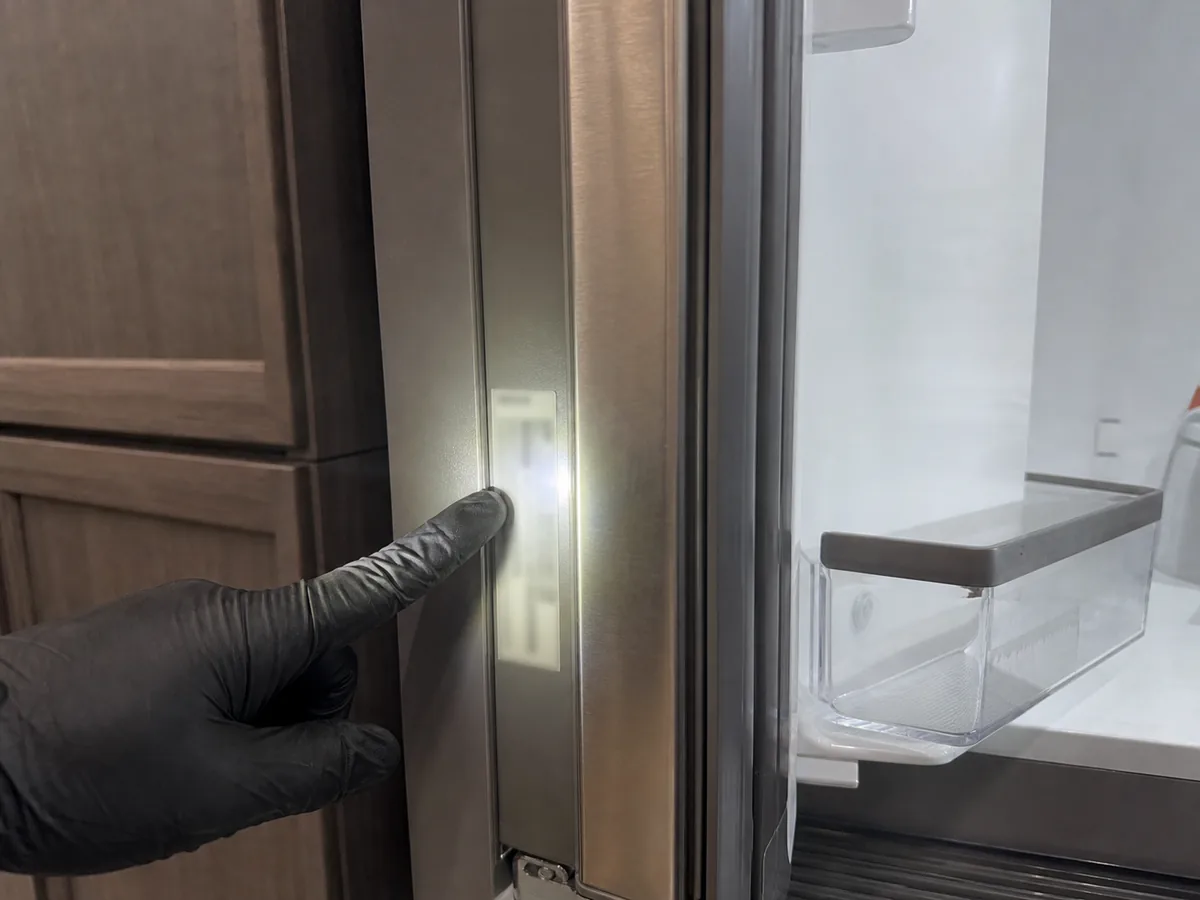
Phone flashlight checking the model plate location inside a built-in refrigerator
Model-tag proof. The serial dates the unit and decides what a code means and which OEM part fits.
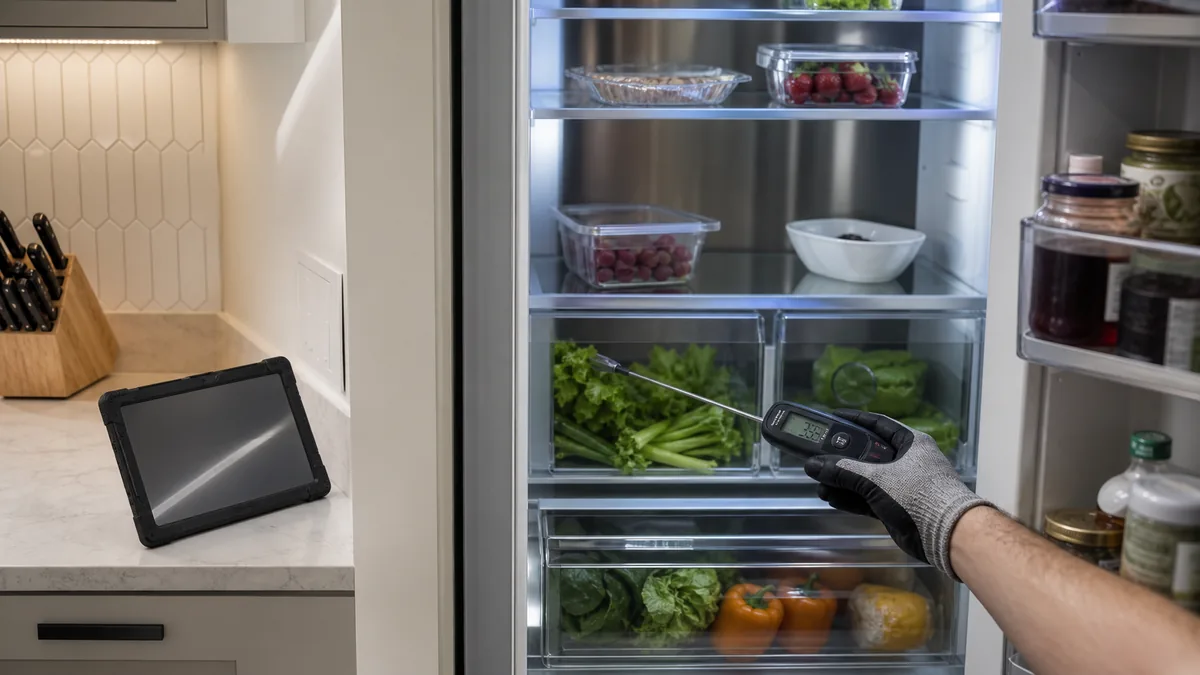
Gloved technician hand measuring refrigerator temperature with a probe inside a built-in stainless refrigerator
Probe readings. Real temperatures against set point — the test that separates an airflow trip from a sealed-system suspicion.
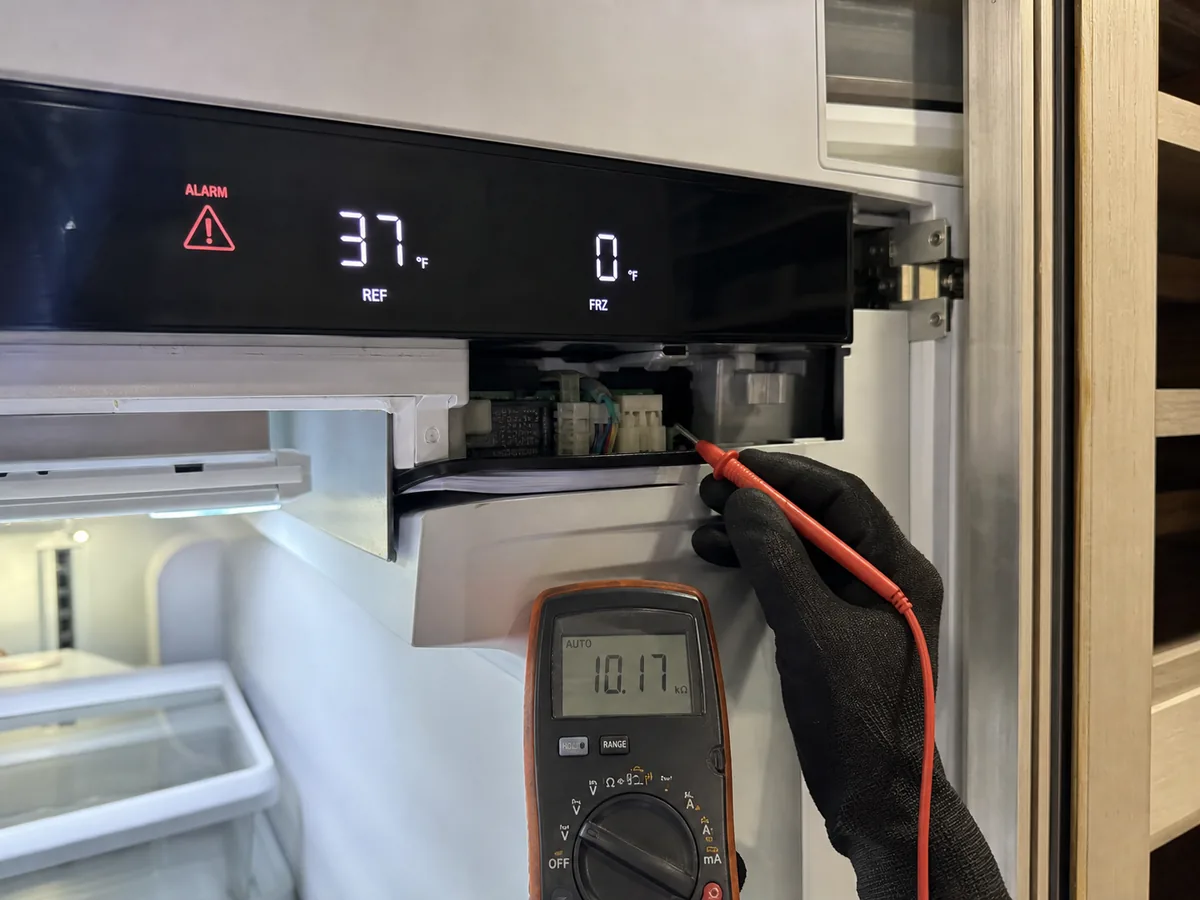
Built-in refrigerator display showing an alarm while a technician tests the control area with a meter
Display plus meter. The alarm is documented in its failed state, then checked against model, serial and instrument readings.

Local service notes

Routing, climate and access around Los Gatos

Where you are changes the realistic repair, not just the drive. Homes along the Los Gatos Creek Trail corridor often sit on narrow, shared driveways where a built-in has to be planned out of its cabinet before we arrive — we confirm access on the intake call so we are not improvising a removal in a tight space. Climate matters too: on warm afternoons routing past Vasona Lake County Park, the dry foothill heat loads condensers harder, so an over-temperature alarm is just as likely to be a dust-packed coil as anything electronic. We work the cheaper airflow suspect first.

For Downtown Los Gatos and the Santa Cruz Avenue blocks, parking and floor protection are part of the plan, not an afterthought. The point of all of it is the same: an alarm gets us to the right neighborhood, but the route, the access and the evidence on site decide the repair.

See full Sub-Zero repair → · Sealed system & compressor → · How to book →

Straight answers

Sub-Zero code & alarm questions

Should I keep resetting my Sub-Zero to clear an alarm?

No. Repeatedly pulling power to clear a code can erase the fault history a technician needs to read, and it masks the real cause. Photograph the display, then leave the unit as-is. We verify the code against the model and serial on site; the repair behind a code typically runs $215-$1,045.

Does a Sub-Zero error code tell you exactly which part failed?

No. A code or alarm narrows the area — a temperature zone, a sensor circuit, the defrost system — but it does not name the failed part. The same alarm can be a door switch, a thermistor, frost on a probe, or a control board. The specific meaning of any code is read against the unit by model and serial, then confirmed with instruments before we quote a part.

Is it safe to keep resetting my Sub-Zero to clear the alarm?

One full power cycle is a reasonable thing to try once. Repeatedly pulling power to silence an alarm is not — it can clear the stored fault history a technician needs to read and can mask an intermittent fault that is still doing damage. If the alarm returns after one reset, leave the unit in its failed state and book a diagnosis.

My Sub-Zero shows condensation and a frost line but no code. Is that normal?

Condensation, a sweaty door, or a frost line at the gasket edge often appears with no code at all, because a leaking door seal is mechanical, not electronic. Warm Los Gatos valley air entering past a compressed or torn gasket condenses and frosts. We read the frost pattern to find where it leaks; it is one of the few faults a homeowner can partly check by feel. See sealed-system & compressor for the costlier cousin of this problem.

When does an alarm mean a sealed-system problem?

An alarm rarely declares a sealed-system fault outright. What raises sealed-system suspicion is a pattern — a compartment that cannot reach set point, a compressor running long, frost in the wrong place — that must then be confirmed by EPA Section 608-regulated pressure and temperature testing. Refrigerant is never assumed from a display; it is verified on instruments.

Why do you need the model and serial before reading a code?

Display behavior, alarm tones and code logic differ across Sub-Zero families and across serial ranges within a family. A symbol on a classic built-in panel does not mean the same thing as on a newer designer touch display. We verify the exact meaning by model and serial rather than trusting a generic chart found online.

How we read it

How we read a Sub-Zero alarm in Los Gatos

  1. Photograph the display. Capture the code before anything is reset so the fault history survives.
  2. Verify by model and serial. The same code means different things across Sub-Zero families — we check the plate.
  3. Read service-mode data. Pull the unit's stored fault data rather than guessing from the alarm.
  4. Isolate the part. Meter the door switch, thermistor, fan or board the code points to.
  5. Clear and confirm. Fix the real cause, clear the history and verify no repeat alarm; repairs run $215-$1,045.

Cost after an alarm is verified

Sub-Zero alarm & error-code repair cost in Los Gatos

Typical Los Gatos ranges once a code is verified on the unit by model and serial, confirmed in writing. The diagnostic is credited to any repair you approve.

Typical Los Gatos ranges after a code is verified
Service / symptomWhat’s includedPrice rangeTypical time
Diagnostic visit (credited)Code verified vs model/serial, service-mode read$135-$21045-90 min
Door switch / sensorOEM switch or thermistor fitted$215-$4301-2 hrs
Evaporator fan (alarm trigger)OEM fan, fault history cleared$365-$6951-3 hrs
Control / interface boardSerial-specific board, re-test$545-$1,0451-4 hrs

Fast fact: A Sub-Zero alarm narrows the area but never names the part — the same code can be a door switch, a thermistor or a board. Typical Los Gatos code-driven repair: $215-$1,045 after the fault is verified on the unit, never from a photo of the display.

Customer reviews

What Los Gatos homeowners value after a Sub-Zero visit

Recent Sub-Zero work across Los Gatos and the West Valley.

A flashing alarm on our BI-48SD in Glenridge (95032) — no idea what it meant. The tech verified the code against the model and serial, found a failed door switch, not the board, and replaced it in under an hour for $230.
Homeowner, Glenridge · alarm / door switch
Display alarm kept tripping on our 736TR in a downtown Los Gatos condo. They metered it instead of guessing, traced a drifting thermistor and replaced the sensor. $300, fault history cleared, alarm gone.
A.R., Downtown Los Gatos · code / thermistor
Persistent error on our 648PRO in Monte Sereno. They read the service-mode data, confirmed a failing control board by serial and fitted the correct one. $820, same day, no repeat alarms.
Homeowner, Monte Sereno · control board
Call (408) 402-4604 Book Online